2026-05-27 00:00:00


Last updated: May 2026. Written by Borja Llopart, Senior Event Planner, CREA Group Events & DMC.
The 2026 Madrid Grand Prix will fill the city with corporate event opportunities, and the first question that reaches an Event Manager is almost never "which venue", but "which venue that actually works on race weekend". They are not the same thing. A space that is perfect on a Tuesday in March can be unworkable on a Saturday in September with the circuit built, streets closed and the city at the limit of its hotel capacity. This guide explains which types of space work for a corporate event around the Madring circuit, how each behaves depending on your group size, what operational constraints race weekend imposes, and the questions to ask a venue before booking it for those dates.
→ Why a race-weekend venue is not chosen like a normal one
→ The four space types and which group each suits
→ The real operational constraints of race weekend
→ What to ask a venue before booking for the GP
→ How the venue fits into the rest of the programme
Most event-space guides start from stable criteria: capacity, location, catering, AV. All of that still matters, but during a Grand Prix weekend three variables get added that simply do not appear at a normal event: access (closed streets, security perimeters, restricted parking), availability (the whole city competes for the same spaces and suppliers on the same dates) and timing (load-in and load-out windows narrow because the circuit environment runs on its own calendar).
This changes the decision hierarchy. Proximity to the circuit, which seems the obvious priority, sometimes works against you: the closest option can be the most affected by access closures. A space slightly further out with a clean transfer route can deliver a better experience than one beside the track that nobody can reach by car. The decision stops being "the closest" and becomes "the best connected for those specific dates".
👉 See how we coordinate corporate events in Madrid.
Rather than a list of names (every project differs and the right venue depends on your specific brief), it helps to think in types. Each solves a different kind of GP corporate event.
1️⃣ The exhibition centre or large-format congress venue.
For conventions, high-volume hospitality or events that combine a business session with a race experience. High capacity, technical infrastructure ready to go, and often the best relationship with the circuit's own calendar when the venue sits within the event environment. It is the default for groups of several hundred people.
2️⃣ The hotel with integrated event space.
For international groups that value having accommodation, meeting rooms and catering in one place, cutting transfers. The operational advantage on GP weekend is huge: every movement you avoid is one less logistical risk. The limit is availability, because these are the first spaces to sell out.
3️⃣ The distinctive or characterful space (rooftop, gastronomic venue, iconic building).
For smaller, high-value hospitality where the experience matters more than capacity. It works very well for a VIP group of clients or executives. It needs more production work and tight access control, but it delivers something a standard ballroom does not.
4️⃣ The flexible corporate space (warehouses, lofts, open-plan spaces).
For brand activations, themed dinners or formats that need total customisation of the staging. It gives creative freedom in exchange for you supplying most of the infrastructure. It is the choice for those who want to build something custom-made around the event.
No type is better in the abstract. The right one depends on group size, the event's objective (business, incentive, client hospitality) and, above all, how it fits the weekend's operation.
CREA Group has coordinated corporate events in Madrid for 19 years, with our own office in the city and first-hand knowledge of how spaces and suppliers behave on high-demand dates. We help you choose the type that fits your group before availability closes.
👉 Tell us your group size and objective.
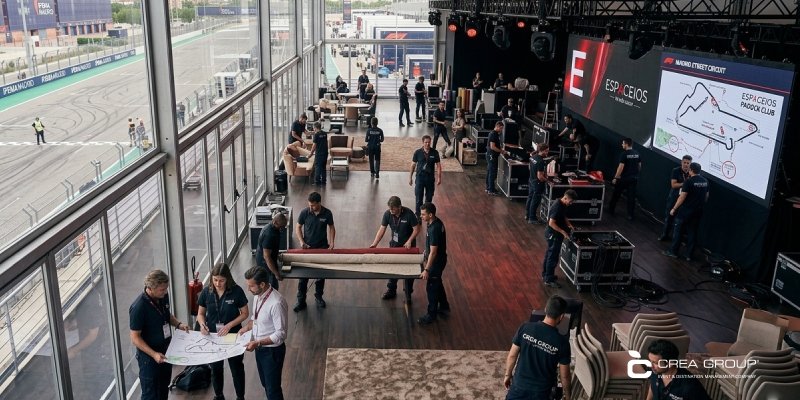
This is what no venue fact sheet shows and only operating in mass-event environments teaches. Three realities that shape which space works:
➝ Access trumps proximity.
During race weekend there are security perimeters, road closures and accredited-access zones. A venue close to the circuit may have its vehicle access restricted right when your guests arrive. The question is not "how many metres away is it", but "how does my group physically arrive that specific day, at that specific time".
➝ Availability closes very early.
On mass-event dates, the good spaces and suppliers are booked far ahead. Booking a venue for GP weekend with the same lead time as a normal event is not realistic. The earlier you close it, the more real options you have.
➝ Load-in windows narrow.
The environment around a Grand Prix runs on its own access calendar, and that compresses load-in, load-out and build times. A production that needs a full day to build may not fit the window the space grants on those dates. Confirm the real window before designing the production, not after.
None of this is a reason not to run the event. It is a reason to plan it with an operator who knows how the environment behaves, and to start earlier than seems necessary.
Before locking a space for Grand Prix weekend, these questions separate a venue that will work from one that will give you scares:
1️⃣ "What vehicle and pedestrian access will the space have that specific weekend, given the planned road closures?"
The answer should be specific to those dates, not the venue's usual situation.
2️⃣ "What is the real load-in and load-out window given the circuit environment's calendar?"
If the venue does not know yet, that is information in itself: it means you or your DMC have to find out.
3️⃣ "What availability of in-house suppliers (catering, AV, staff) do you guarantee on such a high-demand date?"
Many spaces rely on external suppliers who are saturated that weekend. Worth knowing in advance.
4️⃣ "What plan B do you offer if a last-minute access closure affects guest arrival?"
A space experienced in complex dates will have an answer. One without that experience will not.
The venue is one piece, not the programme. A corporate event around the Madrid GP usually includes transfers coordinated with road closures, accreditations for restricted-zone access, catering sized for the real operational window and, often, a hospitality component tied to the race itself. Choosing the venue without thinking about how it connects to those pieces is the most common mistake.
That is why the space decision and the operational decision are made together. The best venue for your group is the one that fits the rest of the programme on the specific weekend, not the one that looks best in a photo. For the full picture of how a hospitality programme is built around the GP, we cover it in the corporate hospitality F1 Madrid guide.
Type | Indicative capacity | Best for | GP-weekend advantage | Watch-out |
Exhibition / congress centre | High (hundreds) | Conventions, volume hospitality | Infrastructure and circuit-calendar link | Needs sized production |
Hotel with integrated space | Medium-high | International groups | Cuts transfers and movements | Sells out early |
Distinctive / characterful space | Small | VIP client hospitality | Experience guests remember | Demanding access control |
Flexible space (warehouse, loft) | Variable | Activations, themed dinners | Total creative freedom | You supply infrastructure |
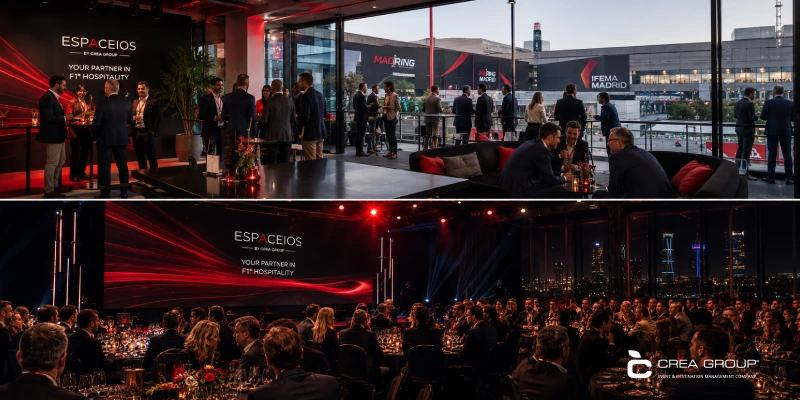
There is no single best venue: it depends on group size and objective. For conventions or volume hospitality an exhibition or congress centre works better; for international groups, a hotel with integrated space that cuts transfers; for a small VIP group, a distinctive characterful space. The key decision on Grand Prix weekend is not proximity to the circuit but real access and the connection to the rest of the programme.
Not necessarily. During race weekend there are road closures and security perimeters, and a very close space may have its vehicle access restricted right when guests arrive. Sometimes a space slightly further out with a clean transfer route offers a better experience. The right question is how your group physically arrives that specific day, not how many metres from the track it sits.
Earlier than seems necessary for a normal event. On mass-event dates the best spaces and suppliers are booked far ahead because the whole city competes for the same resources on the same dates. The earlier the venue is confirmed, the more real options there are and the less you depend on last-minute availability.
Mainly three: access (closed streets, security perimeters, restricted parking), availability (spaces and suppliers saturated by high demand) and timing (narrow load-in and load-out windows from the circuit environment's calendar). Planning with an operator who knows how the environment behaves on high-demand dates reduces these risks.
If your project fits Borja's focus (international incentives, hospitality events, complex operations in Madrid), get in touch about working together.
Last updated: May 2026.

Borja Llopart
Borja Llopart is the CEO and founder of CREA Group Events & DMC. With over 20 years of experience in the MICE industry, he specialises in organising corporate events, congresses, meetings and incentive travel programmes in Spain. He served on the Board of Directors of SITE Spain & Portugal for nearly seven years, including as President of the association, and has been a member of the Tourism Committee at Foment del Treball since 2020.
Connect with Borja on LinkedIn →
Madrid Office: Cl. de Ayala, 82, 5th Floor, Salamanca, 28001 Madrid
Find us on Google Maps
Barcelona Office: Carrer de Santaló, 10, 3-1, Sarrià-Sant Gervasi, 08021 Barcelona
Find us on Google Maps