2026-05-05 00:00:00
Last updated: May 2026. Written by Borja Llopart, Senior Event Planner, CREA Group Events & DMC.
Buying a corporate hospitality package for the Madrid Grand Prix 2026 looks like a simple transaction: you pick the category, pay, and the tickets show up. What happens next is the complicated part. The difference between a hospitality programme that delivers and one that ends in client complaints sits in a layer the official package never covers: transfers, access, timing, guest communication, on-the-ground incident response during race weekend. This guide explains the 5 real hospitality categories you will find for the Madrid 2026 Grand Prix, what each one includes and excludes, how to choose based on the objective of your programme, and the actual operational window to close the purchase before availability runs out.
→ What “corporate hospitality” really means in F1 (and what it doesn’t)
→ The 5 real hospitality categories at the 2026 Madrid Grand Prix.
→ What a professional package MUST include.
→ What it does NOT include and tends to become an unexpected invoice.
→ How to choose based on the programme’s objective.
→ The real operational window to close the purchase.
→ Buying direct vs buying via a DMC: when each makes sense.
“Corporate hospitality” in Formula 1 is not just “a VIP ticket”. It is a structured programme that combines three elements: premium access to the circuit, a curated catering and service experience, and a networking environment designed to give the investment a corporate return. When it gets confused with “tickets plus food”, the programme loses 70% of its value.
What it is not: a premium grandstand with buffet catering and no closed environment. A general ticket with access to a circuit restaurant. A shared box without brand differentiation. A generic VIP product sold through resale.
What it is: a closed or semi-closed space with its own identity, defined capacity control, integrated F&B programme, preferential access to the pit lane or restricted areas (depending on category), dedicated hosts and service, and a coherent experience from before the race (welcome) through to after (post-race wind-down).
For a serious corporate event, this distinction is what justifies the investment. For a personal experience or a one-off gesture to a client, a premium ticket may be enough. Mixing the two up tends to be expensive.
The Madrid Grand Prix 2026 (11-13 September) takes place at the Madring, an urban circuit around IFEMA. Because of the layout (urban, with permanent and street sections) and because it is the inaugural year of the new venue, the hospitality categories actually on the market are:
1️⃣ Paddock Club (Formula 1 Experiences). The official top-tier product. Hospitality access inside the paddock, suites with elevated track views, gourmet catering supervised by a chef, programme including pit lane walks, paddock figures meet-and-greets, car displays. It is the category that sells out first and the one with the strictest capacity rules. Aimed at top clients, C-suite executives, strategic partners. Limited availability and early booking essential.
2️⃣ Champions Club or equivalent. Mid-to-high-tier official hospitality, premium access without paddock entry. High-quality catering, location with strong visibility of a competitive section, entertainment programme. The natural fit for medium corporate groups (15-50 attendees) where you want a premium experience without the Paddock Club price tag.
3️⃣ Private Corporate Suites. Closed private spaces, contracted exclusively by a company or group. They allow own branding, full control of the internal programme (custom catering, presentations, meetings). The category that makes most sense when the corporate event goes beyond “watching the race”: when there is a concrete business objective (launch, strategic networking, awards).
4️⃣ Premium Grandstand with service. Premium grandstand with numbered seating in privileged sections of the circuit, access to reserved catering areas, differentiated services. The most accessible category within real corporate hospitality. Suitable for larger groups (50-150 people) where the main objective is the shared experience.
5️⃣ Trackside Hospitality and parallel events. Temporary or semi-permanent facilities near the circuit, run by authorised providers. They allow a more bespoke programme: gala dinner the night before, trackside brunch on Saturday, post-race close-out on Sunday. This is the category that combines best with a full corporate programme in Madrid (not just confined to race hours).
For many programmes, combining several categories is the model that makes the most sense: Paddock Club for top clients, Premium Grandstand for the rest of the group, and a parallel event at a Madrid venue to bring everyone together.
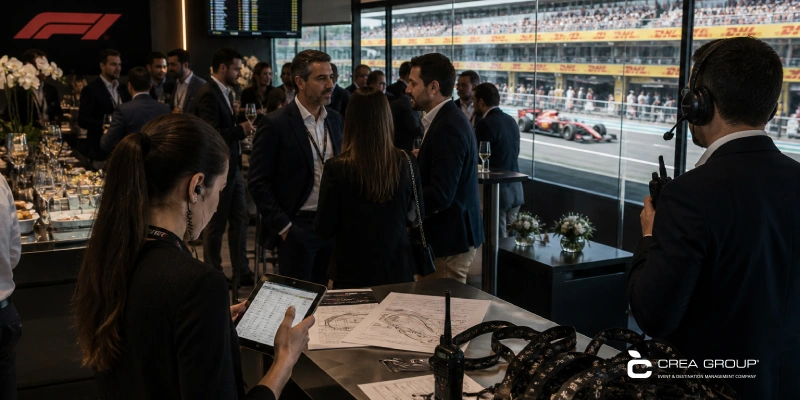
This is the section no commercial brochure explains with the clarity an event manager needs. A professional F1 hospitality package, whatever the category, must include at a minimum:
→ Full access for the 3 event days (Friday practice, Saturday qualifying, Sunday race) or for the days contracted, with clear opening and closing times.
→ Documented catering programme: closed menus with timing, options for allergies and special diets, drinks policy (included vs not, until what hour).
→ Named accreditations: one per guest, with photo and name. Collective accreditations are a sign of an unserious package.
→ Access to parking or to an official drop-off point: at urban circuits like the Madring this is critical because traffic restrictions on race weekend are heavy.
→ Wi-Fi and device charging in the hospitality area.
→ Hosts and orientation staff on site: people who know the circuit and can guide guests who get lost.
→ Clear cancellation and incident policy: what happens if rain interrupts the session, what happens if a guest loses accreditation, what happens if there is a medical issue.
→ Documented operator track record: previous F1-related events, similar cases.
If any of these points is not in writing in the proposal, request it before signing. The gap between having all of this closed and discovering it on Friday morning at 8 am of the GP can wreck the programme.
As important as what is included is what is not. Unexpected invoices on F1 hospitality programmes typically come from:
→ Transfers from accommodation to circuit.
Unless the package specifies otherwise, they are not included. And on a GP weekend in Madrid, with traffic restrictions and limited parking at the Madring, contracting them with 7 days’ notice is 3 to 5 times more expensive than at 90 days.
→ Accommodation during the GP weekend.
Almost never included in the official package. 4-5 star hotels in the IFEMA-Valdebebas area book up 6-9 months in advance. The rate difference between booking in May and booking in August can run 200-300%.
→ Pre-event communication with guests. I
nvitations, welcome dossiers, access instructions, check-in management. If the company doesn’t do it in-house, an agency invoices it separately.
→ Parallel events that give the programme its meaning.
Saturday gala dinner, executive side meetings, sector roundtables: no official package includes them.
→ Space branding (where applicable).
If the company wants to apply its own identity to a corporate suite, specific production must be paid for.
→ Multilingual interpreter or hostess service if the group is international with multiple languages.
→ Operational Plan B if anything fails.
What operations call contingency. It is not in the official package; it is in the professional organiser who manages it.
This is exactly the layer where a DMC with F1 experience (Barcelona, Monaco) reduces the total programme cost despite adding its own management work: because it controls all of these line items with annually negotiated conditions and avoids the last-minute price spikes.
There is no “best” category in the abstract. There is a right category for each business objective. Four typical scenarios and the right fit:
→ Top high-value client (1-4 people).
Paddock Club. It is where the most exclusive experience sits and the environment with the most capacity to generate a real business conversation without distractions.
→ Top high-value clients (5-12 people).
Private Corporate Suite or a Paddock Club + Premium Grandstand combination. The private suite lets you control the environment and adds branding; the Paddock Club delivers exclusivity but dilutes brand differentiation by sharing space with other corporates.
→ Incentive programme for internal team or partners (15-50 people).
Champions Club or Premium Grandstand with reserved catering. Shared experience matters more than individual exclusivity.
→ Wide corporate activation (50+ people).
Section-reserved Premium Grandstand + Trackside Hospitality + parallel event at a Madrid venue. This model combines reasonable cost per person with a documented premium environment for internal and external storytelling.
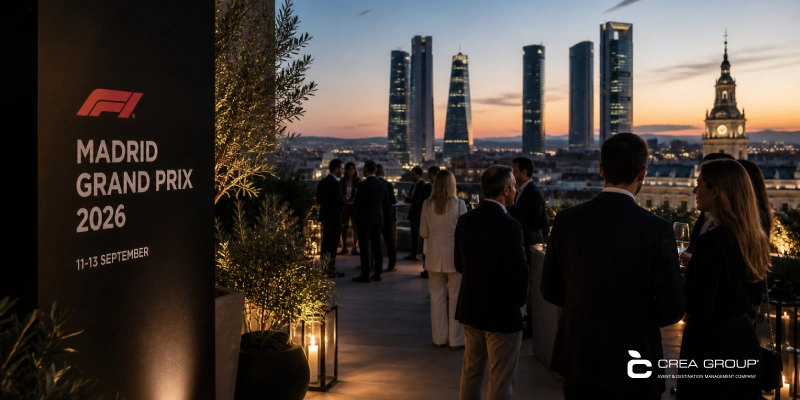
If the objective is a product launch to European partners, F1 corporate hospitality works better combined with a corporate event at an iconic Madrid venue (rooftop, signature space) the night before or after. The race is the anchor; the venue event is where the actual business gets done.
For the Madrid Grand Prix 2026, the actual operational windows are:
→ Up to April 2026 (closed): broad availability across all categories, best rates, 5* hotels available.
→ May-June 2026 (now): Paddock Club almost sold out for the central days (Saturday-Sunday). Champions Club and Private Corporate Suites still with healthy availability. 5* hotels in the IFEMA area with reduced availability.
→ July-August 2026: limited availability in premium categories, possible reassignment between operators. Hotel rates rising significantly. Most operators have closed corporate package negotiations.
→ September 2026 (final weeks): only spot closures, scattered packages, rigid terms. Per-person price may be 2-3 times the early-booking rate.
For any programme of more than 10 people with documented quality expectations, the optimal closing window is 4 to 6 months before the GP, which for Madrid 2026 means March-May.
→ Buying direct from Formula 1 Experiences (Paddock Club) or official operators: makes sense when the programme is for 1-4 attendees, no additional coordination needed, with guests handling their own transfers and accommodation. For that profile, the official operator is the most efficient route.
→ Buying via a DMC with F1 experience: makes sense for programmes of 10+ people requiring coordination of accommodation, transfers, parallel events, communication with international guests, on-site operational presence over the race weekend, incident management and Plan B. For that profile, the DMC reduces the total programme cost because it consolidates line items that otherwise get managed at last-minute premium pricing.
The cleanest way to evaluate it is to request two side-by-side proposals: one direct from the official operator and one from a DMC with everything integrated. The difference is rarely in the price of the official package; it is in what the official package does not cover.
Corporate hospitality F1 Madrid 2026 is not a catalogue product, it is a programme that gets designed. The 5 official categories are the base, but the programme is built in everything the official package does not cover: transfers, accommodation, parallel events, communication, operational Plan B. For groups of any complexity, the cost of not building that layer well is much higher than the cost of the VIP package itself.
If you are considering a corporate hospitality programme for the Madrid Grand Prix 2026, download our Spain 2026 MICE & Corporate Traveler Guide with the operational context of the Spanish corporate events market and the planning criteria you need to calibrate your programme.
Have a defined guest profile and a specific objective?
Tell us the details and we will respond in under 48 hours with a first assessment of which combination of hospitality and parallel programme fits your case.
Per-person price varies significantly by category: from accessible ranges in Premium Grandstand with catering to substantially higher figures in Paddock Club. More important than the headline price is what the package includes and excludes: the real cost of a 20-person programme is not 20 times the package price, but that figure plus transfers, accommodation, parallel events and operational management. Always request a detailed breakdown before comparing prices.
At this point in the year (May 2026), Paddock Club is virtually sold out for the core days. Champions Club and Private Corporate Suites still have healthy availability. Premium Grandstand and trackside hospitality offer more flexibility. For programmes of more than 10 people with quality expectations, closing before July is advisable.
It is possible, but the total cost tends to be higher than a coordinated programme and execution quality more variable. If the programme is for external clients or partners where reputational risk matters, it is not recommended. For personal use or a one-off gift, it can make sense.
Paddock Club is the official Formula 1 Experiences product with paddock access and a shared experience with other corporates in the area. The Private Corporate Suite is a space contracted exclusively by one company, with own branding and a controlled internal programme. The choice depends on whether you value access exclusivity (Paddock) or environment control (Private Suite) more.
Borja Llopart is the CEO and founder of CREA Group Events & DMC. With over 20 years of experience in the MICE industry, he specialises in organising corporate events, congresses, meetings and incentive travel programmes in Spain. He served on the Board of Directors of SITE Spain & Portugal for nearly seven years, including as President of the association, and has been a member of the Tourism Committee at Foment del Treball since 2020.
👉 Connect with Borja on LinkedIn.
📍 Madrid Office: Cl. de Ayala, 82, 5th Floor, Salamanca, 28001 Madrid.
Find us on Google Maps
📍 Barcelona Office: Carrer de Santaló, 10, 3-1, Sarrià-Sant Gervasi, 08021 Barcelona.
Find us on Google Maps
Last updated: May, 2026.