November 2026 | By Eva Nieuwkoop, Account Manager, CREA Group Events & DMC
The incentive travel landscape is changing. For US companies planning programs in 2027, choosing a destination involves more than finding an exceptional hotel or designing a memorable itinerary. Safety, geopolitical stability, international air access and reliable local partners are becoming increasingly important.
The Incentive Travel Index 2026, a joint research initiative by the Society for Incentive Travel Excellence (SITE) and the Incentive Research Foundation (IRF), reveals an interesting combination of priorities: American incentive buyers want destinations they have not used before, but they also favor top-tier accommodations, established resorts and places where participants will feel welcome.
Spain offers an opportunity to combine the excitement of discovering somewhere new with the reassurance of a mature international destination.
Barcelona and Madrid remain two of Europe's leading MICE destinations and major gateways for US travelers. Beyond these cities, established resort destinations such as Tarragona – Costa Daurada, Sitges, Málaga – Costa del Sol and Mallorca – Balearic Islands offer a different kind of incentive experience, supported by Spain's extensive hospitality infrastructure.
For American planners, the possibilities extend from a premium resort-based program to a city-based incentive or a combined itinerary bringing together both.
As an Account Manager at CREA Group Events & DMC and a board member of SITE Spain & Portugal, I have examined the latest research with one question in mind: how can Spain respond to the priorities shaping US incentive travel in 2027?
INDEX
→ What Are the Biggest Incentive Travel Trends for 2027?
→ Why Is Spain a Strategic Incentive Travel Destination for US Companies?
→ Barcelona and Madrid: Established MICE Destinations and Gateways to Discover Spain→
Beyond Barcelona and Madrid: Spain's Resort Destinations for 2027
→ Top-Tier Resorts and Hospitality Standards for American Incentive Groups
→ Is Spain a Safe Destination for US Corporate Incentive Travel?
→ Direct Flights From the United States: Spain's International Accessibility
→ Beach, Sunshine and Meaningful Experiences: What Motivates Incentive Travelers?
→ Budget Predictability: Spain and the Euro
→ Why an Experienced Local DMC Matters for Incentive Travel in Spain
→ What Should US Incentive Planners Consider Before Booking Spain for 2027?
→ Frequently Asked Questions About Incentive Travel in Spain
→ Looking Ahead: Spain's Opportunity in the 2027 Incentive Travel Market
What Are the Biggest Incentive Travel Trends for 2027?
SITE's Incentive Travel Index 2026 identifies a market that continues to value exceptional experiences while becoming more selective about destination choice.
Three findings are particularly relevant for US companies.
1️⃣ New destinations lead, but established resorts remain attractive
The strongest destination trend among US buyers is the growing interest in places their companies have never used before, with a net score of +69.
At the same time, buyers expect increased use of all-inclusive resorts (+36), resort destinations (+35) and high-profile, established destinations (+32).
Destination type | Net score among US buyers |
|---|---|
New destinations not previously used | +69 |
All-inclusive resorts | +36 |
Resort destinations | +35 |
High-profile, established destinations | +32 |
Destinations closer to participants' point of origin | +26 |
Urban destinations | −6 |
Source: SITE & IRF, Incentive Travel Index 2026, slide 11. Net scores represent the percentage expecting increased use minus the percentage expecting decreased use.
The message is not that incentive buyers want to abandon familiar standards. They want to introduce participants to new experiences without compromising comfort, quality or reliability.
This distinction is particularly relevant for Spain, where internationally established resort destinations may still be unfamiliar to many American incentive groups.
2️⃣ Safety and air access are decisive
➝ Personal safety is the most frequently cited destination disqualifier among US buyers, selected by 53% of respondents.
➝ Difficult air access follows at 42%, with geopolitical factors at 31%, inadequate infrastructure at 26% and cost at 24%.
The same research identifies the features American buyers actively seek:
Destination must-have | US buyers |
|---|---|
Top-tier accommodations | 41% |
Direct air access | 36% |
Resort setting | 27% |
Welcoming to US qualifiers | 26% |
Bucket-list destination recognition | 25% |
Presence of a good DMC | 19% |
Source: SITE & IRF, Incentive Travel Index 2026, slides 13–14; US buyers, n=289.
Together, these findings suggest that a successful incentive destination must combine emotional appeal with practical confidence.
3️⃣ Air capacity and currency volatility require earlier planning
➝ Securing airlift has become a much more significant concern among US incentive buyers, rising from 12% in the previous survey to 40% in 2026.
➝ Concerns about international instability increased from 22% to 33%, while exchange-rate volatility rose from 10% to 22%.
For programs planned months in advance, these challenges make early destination evaluation, flight coordination and financial planning particularly important.
Why Is Spain a Strategic Incentive Travel Destination for US Companies?
Spain combines many of the characteristics American incentive planners now prioritize: extensive international connectivity, premium hospitality, diverse destinations, established MICE infrastructure and a welcoming environment for international visitors.
Its appeal also benefits from a favorable outlook for Western Europe.
In SITE's 2026 destination ranking, Western Europe ranks second among the regions North American buyers expect to use more, behind the Caribbean and ahead of the United States.
The Caribbean holds the benchmark score of 100, followed by Western Europe at 85 and the United States at 70.
These figures refer to Western Europe as a region, not Spain individually. Nevertheless, they illustrate the continued attractiveness of European destinations to North American incentive buyers.
International experience and established infrastructure
Spain has decades of experience hosting international conferences, corporate events and incentive programs.
In ICCA's 2025 Country & City Rankings, Spain ranked fourth worldwide for international association meetings. Barcelona placed third among cities, with 166 qualifying meetings, while Madrid ranked thirteenth.
Although association congresses and incentive programs are different segments, these rankings demonstrate the depth of Spain's international meetings infrastructure.
The country also continues to attract substantial numbers of American visitors.
Spain welcomed approximately 4.45 million US travelers in 2025. Between January and August 2026, arrivals from the United States reached approximately 3.36 million, an increase of 11.6% year over year, according to Spain's National Statistics Institute (INE).
For incentive planners, this established relationship with the American market is supported by experienced hospitality teams, international hotel brands, professional suppliers and a wide range of destinations.
Barcelona and Madrid: Established MICE Destinations and Gateways to Discover Spain
Barcelona and Madrid occupy a distinctive position in Spain's incentive travel market.
Both are internationally recognized destinations for meetings, conferences and corporate events, with upscale hotels, exceptional gastronomy, cultural attractions and extensive experience welcoming international groups.
They are also two of Europe's most important air gateways.
According to Eurostat, Madrid-Barajas was the European Union's third-busiest airport by passenger traffic in 2025, while Barcelona-El Prat ranked fifth.
Both offer extensive international connections, including nonstop flights to multiple US cities.
For American incentive planners, this creates three attractive possibilities.
1️⃣ A complete incentive program in Barcelona or Madrid
Both cities are destinations in their own right.
Barcelona combines Mediterranean character, distinctive architecture, cultural experiences, gastronomy and an established international events industry.
Madrid offers exceptional museums, historic venues, premium hospitality, culinary experiences and access to the cultural heritage of central Spain.
👉 For companies seeking a sophisticated European city experience, either destination can host an entire incentive program.
Barcelona's appeal is also reflected in the programs international companies choose to organize there. In 2026, CREA worked alongside a Canadian travel agency to deliver a five-day incentive for approximately 400 top-performing franchisees of a North American automotive services company. The program brought together cultural visits, private dining, a welcome event and an awards gala, with participants able to select activities through a dedicated online platform.
The combination of a recognizable destination and personalized experiences allowed the program to accommodate different interests within a large group. It achieved 98.9% attendance and 98.22% reported participant satisfaction, with no critical operational incidents.
2️⃣ A major international gateway to a new destination
Barcelona and Madrid can also serve as arrival and departure points for groups traveling elsewhere in Spain.
Participants arriving in Barcelona can continue to Sitges or Tarragona – Costa Daurada. Madrid offers convenient onward connections to destinations such as Seville and La Rioja.
Other Spanish airports, including Málaga and Palma de Mallorca, expand the possibilities for groups whose programs are centered on coastal resorts or island destinations.
In this format, the main city airport serves as the gateway, while the incentive experience takes place entirely in the selected regional destination.
3️⃣ A combined city-and-resort incentive
A third possibility is to combine the familiarity of an internationally recognized city with the excitement of a new destination.
For example, a group might spend one or two nights in Barcelona, enjoying its architecture, restaurants and cultural attractions, before continuing to a Mediterranean resort in Sitges or the Costa Daurada.
Alternatively, participants could begin in Madrid before traveling to Seville or another Spanish region.
These combinations allow companies to design varied programs within a single country, using established transportation networks and experienced local suppliers.
Barcelona and Madrid are therefore both destinations and strategic gateways, complementing rather than competing with Spain's lesser-used incentive locations.
Beyond Barcelona and Madrid: Spain's Resort Destinations for 2027
One of Spain's strongest advantages is the diversity of experiences available beyond its two largest international MICE centers.
The destinations attracting interest from incentive planners are not necessarily new to international tourism. Many have longstanding upscale hospitality industries, experienced resort teams and infrastructure developed for sophisticated international travelers.
What makes them particularly relevant in 2027 is the opportunity they offer companies to introduce participants to somewhere they have not previously visited.
1️⃣ Tarragona – Costa Daurada: Mediterranean resorts and integrated experiences
Located south of Barcelona, Tarragona – Costa Daurada combines Mediterranean beaches, resort hospitality, golf courses and a wide range of leisure activities.
Its established tourism infrastructure supports programs built around resort accommodation, group dining, entertainment and outdoor experiences.
The PortAventura World and INFINITUM areas illustrate the region's integrated hospitality and leisure offering.
For American groups, Costa Daurada provides a resort-focused alternative to Barcelona while remaining connected to the city's international airport.
It can work as a standalone incentive destination or as the second stage of a combined Barcelona itinerary.
2️⃣ Sitges – Barcelona: Coastal sophistication and accessibility
Sitges offers the atmosphere of a Mediterranean coastal town within easy reach of Barcelona's international airport.
Its upscale hotels, golf facilities, seafront, restaurants and historic center create an attractive setting for corporate incentive programs.
Activities can include sailing, golf, private dining, cultural experiences and excursions to Barcelona.
For groups arriving from different US cities, Sitges combines a relaxed coastal environment with the practical advantages of a major international gateway nearby.
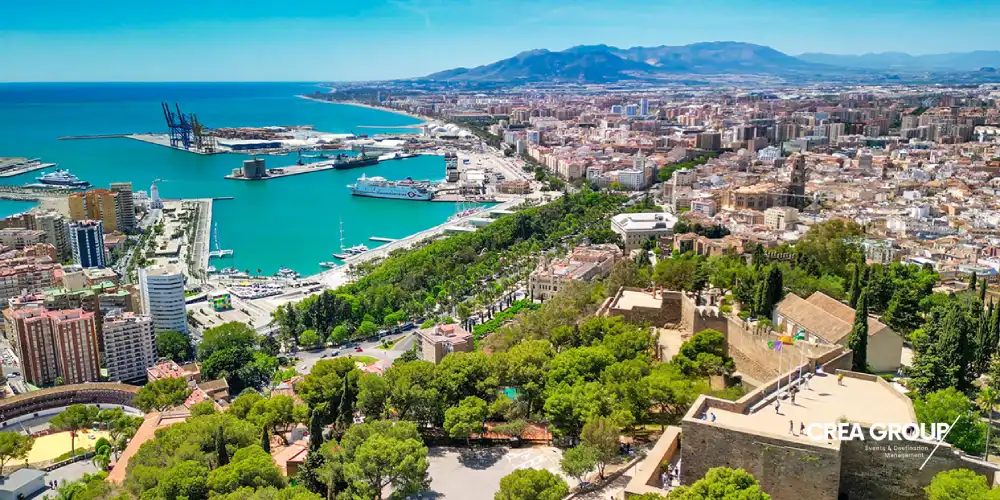
3️⃣ Málaga – Costa del Sol: Premium resorts, golf and Mediterranean lifestyle
Málaga – Costa del Sol is one of Spain's most established international resort destinations.
From Marbella to Sotogrande, the region offers five-star resorts, renowned golf courses, beach clubs, fine dining and a sophisticated Mediterranean atmosphere.
Many properties have extensive experience accommodating international corporate groups and organizing programs that combine relaxation, networking, private events and leisure activities.
Málaga-Costa del Sol Airport provides extensive European connectivity alongside transatlantic services.
For US companies seeking a high-end resort experience, the Costa del Sol offers a wide choice of settings, from beachfront hospitality to golf and wellness retreats.
The destination's versatility extends beyond leisure. In 2026, CREA organized two programs in Málaga – Costa del Sol for a European-based medical technology company specializing in advanced endovascular devices. The first was an annual sales kickoff in January; the second, held in June following the successful delivery of the first, combined an incentive experience with the presentation of a new product portfolio.
Each program involved approximately 100 participants over four days, with operations conducted in four languages. The scope extended from hotel accommodation, plenary sessions and product workshops to audiovisual engineering, stage design, cultural activities and beach club celebrations.
The different objectives shaped the event design. January's convention used an elevated stage for formal presentations, while June's program adopted a floor-level configuration to encourage closer interaction. Separate operational teams coordinated activities inside and outside the hotel, including late-night transportation and departure transfers.
The reported results included 99.1% attendance, 99.35% participant satisfaction and final expenditure 6.8% below the initial budget.
These programs illustrate how an established resort destination can accommodate both structured corporate content and the more experiential elements of an incentive trip.
4️⃣ Mallorca – Balearic Islands: Mediterranean island experiences
Mallorca – Balearic Islands combines the appeal of an island destination with an established premium hospitality industry.
Its coastline, marinas, golf courses, resorts and natural landscapes offer a distinctive setting for incentive travel.
Programs can incorporate private sailing, wellness, coastal excursions, gastronomy, golf and cultural experiences.
The island's hospitality sector includes leading American, Spanish and other international hotel brands, with experienced teams accustomed to welcoming guests from different markets.
Mallorca is particularly attractive for companies seeking a resort-based incentive that combines relaxation with memorable activities.
5️⃣ Seville and La Rioja: Culture and gastronomy
Spain also offers compelling alternatives beyond its coastal destinations.
➝ Seville brings together Andalusian architecture, historic venues, cultural traditions and exceptional gastronomy. Its high-speed rail connections with Madrid make it suitable for standalone programs and combined itineraries.
➝ La Rioja offers a more intimate experience centered on vineyards, wine estates, regional cuisine and the landscapes of northern Spain.
These destinations can be particularly effective for incentives emphasizing cultural discovery, gastronomy and authentic local experiences.
Top-Tier Resorts and Hospitality Standards for American Incentive Groups
With 41% of US buyers identifying top-tier accommodations as a destination must-have, the quality of Spain's upscale hospitality sector is a significant competitive advantage.
Spain has a strong presence of leading American hotel brands, alongside established Spanish and other international hospitality groups.
Importantly, the ability to meet American service expectations is not limited to US-owned brands.
Many Spanish high-end resorts have English-speaking teams, extensive international experience and a strong understanding of corporate group requirements.
This includes coordinated arrivals, rooming lists, private dining, dietary requirements, meeting facilities, hospitality services and exclusive activities.
Resort-based incentive programs can also benefit from flexible dining arrangements.
Depending on the property, planners may negotiate half-board, full-board or customized packages combining accommodation, meals, beverages, entertainment and activities.
Although full-board is not necessarily the same as all-inclusive, these arrangements can offer many of the operational advantages associated with a comprehensive resort program.
The objective is not to select the largest or most recognizable property. It is to identify a resort whose location, facilities, service standards and atmosphere match the incentive's purpose.
Is Spain a Safe Destination for US Corporate Incentive Travel?
Safety and geopolitical stability are increasingly important considerations for international incentive programs.
SITE's research shows that 53% of US buyers identify personal safety as a destination disqualifier, while 31% cite geopolitical concerns.
Spain offers an attractive combination of political stability, a peaceful environment, established international relationships and mature tourism infrastructure.
Its longstanding diplomatic, economic and cultural ties with the United States contribute to a familiar and welcoming environment for American visitors.
The country also has extensive experience accommodating international travelers, with hospitality professionals accustomed to different languages, nationalities and expectations.
For American companies, Spain's established hospitality industry, professional services and stable international environment provide a reassuring foundation for incentive travel.
Direct Flights From the United States: Spain's International Accessibility
International air access is central to destination selection.
According to SITE, 42% of US buyers consider difficult air access a reason to reject a destination, while 36% identify direct flights as a must-have.
Spain benefits from an extensive transatlantic network.
According to Turespaña, using OAG aviation data, 27 nonstop routes connected 13 US cities with six Spanish cities in 2026.
Madrid and Barcelona are the principal international gateways, while Málaga and other Spanish airports provide additional possibilities for reaching regional destinations.
For incentive planners, this connectivity creates flexibility.
Groups can arrive directly in one of Spain's major cities, continue by road or rail to nearby destinations, or use domestic and connecting flights to reach other regions.
➝ A Barcelona arrival can support a program in Sitges or the Costa Daurada.
➝ Madrid provides access to central Spain and high-speed rail connections to Seville.
➝ Málaga serves the Costa del Sol, while Mallorca can be reached through its own international airport or connecting services.
Actual flight schedules, seasonal routes and group air capacity should be evaluated early, particularly for participants traveling from several US departure cities.
Spain's combination of international gateways and established domestic transportation networks makes it possible to develop incentive programs across a wide range of destinations without sacrificing accessibility.
Beach, Sunshine and Meaningful Experiences: What Motivates Incentive Travelers?
A successful incentive program must do more than provide an attractive destination.
It should motivate participants to qualify, reward their achievements and create lasting memories.
SITE's Incentive Travel Index 2026 explores three dimensions of incentive experiences: motivational, memorable and meaningful.
Experience | Motivational | Memorable | Meaningful |
|---|---|---|---|
Beach and sunshine | 72% | 42% | 21% |
International travel | 50% | 43% | 45% |
Adventure travel | 31% | 51% | 39% |
Historical locations | 17% | 39% | 35% |
Natural surroundings | 17% | 31% | 34% |
Source: SITE & IRF, Incentive Travel Index 2026, slide 23.
Beach and sunshine experiences stand out as particularly strong motivators, selected by 72% of respondents.
Spain's Mediterranean and Atlantic coastlines provide an obvious advantage in this area, with a wide range of resort settings and outdoor experiences.
However, the research also shows that other activities contribute strongly to the lasting impact of an incentive.
International travel, adventure, historic locations and natural surroundings can provide memorable and meaningful experiences beyond the initial appeal of the destination.
Spain makes it possible to combine these elements within a single program.
A Mediterranean resort might provide the setting, while private cultural visits, regional gastronomy, sailing, golf, outdoor activities and local traditions create the experiences participants remember.
For larger incentive groups, personalization also matters. Giving participants a choice of activities, accommodating different dietary needs and balancing shared celebrations with smaller experiences can help create a program that feels individual rather than standardized.
This combination of comfort, discovery and authenticity is particularly well suited to international incentive travel.
Budget Predictability: Spain and the Euro
Exchange-rate volatility is becoming a more significant concern among US incentive buyers.
SITE's research shows that 22% now identify it as a short-term challenge, compared with 10% in the previous survey.
Spain offers a practical advantage as a member of the eurozone.
Hotels, transportation providers, venues and other local suppliers generally quote and invoice in euros.
For a destination management company operating and contracting in euros, this avoids the additional exchange-rate exposure that may arise when suppliers in another country charge in a different local currency.
For American clients, the USD/EUR exchange rate remains relevant and should be considered when agreeing budgets, payment schedules and contractual terms.
Nevertheless, euro-denominated supplier contracts simplify local financial planning and can support greater budget predictability.
Spain also benefits from the European Union's shared regulatory framework, which provides a degree of consistency for international companies working across EU destinations.
National legislation and contractual requirements still differ, but the broader European framework supports a more predictable environment for international business and travel.
Why an Experienced Local DMC Matters for Incentive Travel in Spain
A destination's appeal is only one part of a successful incentive program.
Local expertise, established supplier relationships and reliable operational coordination are essential to translating an attractive concept into a well-executed experience.
SITE's research identifies the presence of a good destination management company as a must-have for 19% of US buyers.
Another finding highlights the importance of informed local advice: when safety concerns arise, 44% of surveyed industry professionals say they are likely or very likely to educate their clients rather than change destination, compared with 14% who would be likely to switch.
That advice is most useful when it comes from professionals with direct experience of the destination.
CREA Group events & DMC: Local expertise across Spain
CREA Group events & DMC has been operating since 2007, with its headquarters in Barcelona and a branch office in Madrid.
From these two operational bases, CREA delivers corporate events, meetings and incentive programs across Spain, including Málaga - Costa del Sol, Tarragona - Costa Daurada, Sitges, Mallorca - Balearic Islands, Seville, Valencia, La Rioja and the Basque Country.
Our work combines destination knowledge, venue selection, accommodation, transportation, activities, hospitality services, entertainment and on-site coordination.
➝ CREA is a member of SITE, ADMEI, MPI and PCMA and certified by the IATA.
➝ Our founder, Borja Llopart, previously served as president of SITE Spain & Portugal, while I currently serve on the chapter's board.
➝ Alongside our operations in Spain, CREA also has experience delivering corporate events in leading European MICE destinations, including Paris, Milan, Frankfurt, Amsterdam and the French Riviera.
Operational experience when plans become more complex
The value of local expertise often becomes most apparent in the details participants never see: coordinating arrivals, adapting to changing circumstances, managing several suppliers simultaneously and keeping the program running smoothly.
In 2024, CREA managed five consecutive editions of an international corporate event in Barcelona for an industrial company. Across six days, the program welcomed more than 1,700 attendees and operated in 20 working languages, with successive groups arriving and departing throughout the event.
When a transportation strike was announced during the program period, the team monitored developments and prepared alternative arrangements. The strike was subsequently called off, but the situation demonstrated the importance of contingency planning and close coordination with local providers.
The event achieved attendance equivalent to 99.4% of confirmed RSVPs and closed 8.9% below budget.
Experience of this kind is relevant to incentive travel, even when the event format differs. Large international programs depend on the same underlying capabilities: reliable suppliers, detailed planning, responsive coordination and the ability to adapt without compromising the participant experience.
👉 For US companies, an experienced local DMC brings these operational capabilities together with destination knowledge, helping planners focus on the purpose of the incentive rather than the complexity of delivering it.

What Should US Incentive Planners Consider Before Booking Spain for 2027?
Several practical decisions can make a significant difference when organizing an international incentive program.
1️⃣ Flight availability and arrival logistics
Review nonstop routes, seasonal schedules and group air capacity early in the planning process.
For programs involving multiple departure cities, consider whether a common arrival gateway or coordinated transfers will provide the best participant experience.
2️⃣ Destination and accommodation selection
Choose the destination according to the program's objectives, not simply its popularity.
A city-based incentive, Mediterranean resort, cultural destination or combined itinerary will offer different experiences.
Hotel standards, dining arrangements, meeting facilities, private event spaces and available activities should all be evaluated.
3️⃣ European entry requirements: EES and ETIAS
The European Union's Entry/Exit System (EES) became fully operational on April 10, 2026. It introduces digital registration, including biometric information, for eligible non-EU travelers entering the Schengen area for short stays.
The European Travel Information and Authorization System (ETIAS) is a separate initiative that will introduce a travel authorization requirement for eligible visa-exempt visitors, including US citizens.
As of November 2026, ETIAS is not yet operational and the European Union has not confirmed an exact implementation date.
US travelers do not need to apply while the system remains inactive.
Planners should consult the European Union's official travel information before finalizing documentation and participant communications.
4️⃣ Currency and contractual arrangements
For programs quoted in euros, agree payment schedules, cancellation conditions and any applicable currency provisions in advance.
US companies budgeting in dollars should consider the USD/EUR exchange rate when planning their programs.
5️⃣ Participant communications
Pre-departure information should cover arrival procedures, transportation, local customs, dining schedules, appropriate clothing and the program itinerary.
Clear communication helps international participants feel comfortable and prepared from the beginning of the experience.
Key figures: incentive travel to Spain (2027)
➝ +69 net score for new destinations not previously used, the strongest destination trend among US incentive buyers. (Source: SITE & IRF, Incentive Travel Index 2026, October 2026)
➝ 53% of US buyers name personal safety as a reason to rule out a destination, the most cited disqualifier. (Source: SITE & IRF, Incentive Travel Index 2026, October 2026)
➝ 40% of US buyers see securing airlift as a challenge, up from 12% in the previous survey. (Source: SITE & IRF, Incentive Travel Index 2026, October 2026)
➝ 27 nonstop routes connected 13 US cities with six Spanish cities in 2026. (Source: Turespaña with OAG data, August 2026)
➝ 3.36 million US travelers visited Spain between January and August 2026, up 11.6% year over year. (Source: INE, Frontur, October 2026)
Frequently Asked Questions About Incentive Travel in Spain
What are the main incentive travel trends for 2027?
According to SITE's Incentive Travel Index 2026, US buyers show increasing interest in new destinations, premium resorts and all-inclusive experiences. Safety, direct air access, welcoming environments and reliable local partners are also important destination-selection factors.
Why is Spain a good incentive travel destination for US companies?
Spain combines extensive international air connections, top-tier accommodations, established MICE infrastructure, a welcoming hospitality culture and diverse destinations. American companies can choose between major cities, Mediterranean resorts and cultural regions, or combine several experiences in one program.
What are the best incentive travel destinations in Spain?
Barcelona and Madrid remain leading international MICE destinations. Tarragona – Costa Daurada, Sitges – Barcelona, Málaga – Costa del Sol and Mallorca – Balearic Islands offer established resort environments, while Seville and La Rioja provide distinctive cultural and gastronomic experiences.
Can an incentive program combine Barcelona or Madrid with another destination?
Yes. A program can begin with one or two nights in Barcelona or Madrid before continuing to a coastal resort or regional destination. Alternatively, these cities can serve solely as international gateways, with the entire incentive experience taking place elsewhere in Spain.
Does Spain have nonstop flights from the United States?
Yes. Turespaña and OAG reported 27 nonstop routes connecting 13 US cities with six Spanish cities in 2026. Madrid and Barcelona are major gateways, with additional transatlantic access through other Spanish airports. Availability varies by route and season.
Are there top-tier resorts in Spain suitable for American incentive groups?
Yes. Spain has an established selection of five-star resorts experienced in welcoming international corporate groups. Depending on the property, planners can arrange half-board, full-board or customized packages incorporating accommodation, dining and activities.
Do US travelers need ETIAS to visit Spain in 2027?
As of November 2026, ETIAS is not operational and no exact implementation date has been confirmed by the European Union. US travelers should check official EU guidance before departure for the requirements applicable at the time of travel.
Why work with a DMC for an incentive program in Spain?
An experienced destination management company provides local knowledge, established supplier relationships and coordinated planning for accommodation, transportation, venues, activities and hospitality services. This helps international companies develop programs that are both distinctive and operationally reliable.
Looking Ahead: Spain's Opportunity in the 2027 Incentive Travel Market
SITE's Incentive Travel Index 2026 points to a clear evolution in international incentive travel.
American buyers want destinations that feel new and inspiring, but they are also placing greater emphasis on safety, accessibility, accommodation standards and operational reliability.
Spain brings these priorities together.
Barcelona and Madrid provide internationally recognized MICE destinations and major gateways from the United States. Beyond them, the Mediterranean resorts of the Costa Daurada, Sitges, the Costa del Sol and Mallorca, alongside cultural destinations such as Seville and La Rioja, offer opportunities for companies seeking something different.
For US incentive planners, the choice is not simply between an established destination and a new one.
Spain makes it possible to enjoy both: the confidence of a mature international hospitality market and the excitement of discovering a destination participants may never have experienced before.
👉 Planning a corporate incentive program in Spain for 2027?
CREA Group Events & DMC can help identify the right destination, design the program and coordinate its delivery, from the initial planning stages to the final departure.
Where to go next
1️⃣ If you are still comparing Spanish destinations.
Our guide on why US companies choose Spain for MICE compares five Spanish cities.
2️⃣ If you already have dates and a group size.
Our team sends you a booking calendar for your Spain incentive, with a deadline for each supplier, within 48 hours.
3️⃣ If you want to discuss what the 2027 research means for your program.
Talk through your program with Eva Nieuwkoop. CREA has organized events and incentives in Spain since 2007 and has held Biosphere certification since 2019.
About the author

Eva Nieuwkoop
Eva Nieuwkoop is an Account Manager at CREA Group Events & DMC, where she specialises in the planning and delivery of corporate events, meetings and incentive travel programmes across Spain and the rest of Europe. With an international background and a Master of Science in Tourism Development & Culture, she brings a destination-focused perspective and a strong interest in creating meaningful experiences that connect people, places and businesses. She also serves on the board of SITE Spain & Portugal, contributing to the chapter's Young Leaders and Communications initiatives.
Connect with Eva on LinkedIn →
Madrid Office: Cl. de Ayala, 82, 5th Floor, Salamanca, 28001 Madrid
Find us on Google Maps
Barcelona Office: Carrer de Santaló, 10, 3-1, Sarrià-Sant Gervasi, 08021 Barcelona
Find us on Google Maps
Last updated: November 2026.