2026-06-07 00:00:00


Last updated: May 2026. Written by Borja Llopart, Senior Event Planner, CREA Group Events & DMC.
Organising a company event on any normal weekend is one thing. Organising it on the weekend of a Formula 1 Grand Prix is quite another, because the normal list gains variables that only appear when an entire city revolves around a mass event. What works on a Tuesday can be impossible on a race Saturday. This checklist comes from operating in high-demand environments and is built so that what really slips through does not slip through. Here is the full checklist, ordered by moment (at booking, weeks before, race week and the day itself), for organising a corporate event during a Grand Prix without avoidable scares.
→ Why a GP changes your usual checklist.
→ At booking (3-6 months before).
→ Weeks before (planning).
→ Race week (confirmations).
→ Event day (execution).
→ The three errors that repeat most.
A normal corporate event is planned on available resources. An event during a Grand Prix is planned on scarce resources and a shifting environment. Three factors change everything: availability (the whole city competes for the same spaces and suppliers), access (road closures and security perimeters that do not exist the rest of the year) and timing (load-in windows compressed by the sporting event's own calendar).
The practical consequence is that a GP checklist is not the normal one with more items: it is the normal one with a different order and brought-forward deadlines. What you usually leave for three weeks before is decided three months ahead here. For the full context of how a programme is built around the Madrid GP, we develop it in the corporate hospitality F1 Madrid guide.
👉 See how we coordinate events on high-demand dates in Madrid.
The most important block, because it is the one you cannot recover if done late:
• ➝ Confirm the exact event date against the Grand Prix calendar (practice, qualifying, race).
• ➝ Book the venue, verifying its real access that weekend, not its usual situation.
• ➝ Block accommodation for the group before hotels sell out.
• ➝ Lock the key suppliers (catering, AV, transport), which get saturated on these dates.
• ➝ Define the budget with a larger contingency margin than usual, because last-minute extras add up.
With the critical items booked, you refine the plan:
• ➝ Design transfer routes accounting for the planned road closures, not the normal map.
• ➝ Handle accreditations and access to restricted zones with the lead time the event requires.
• ➝ Confirm the real load-in and load-out window with the venue.
• ➝ Prepare an access plan B in case of last-minute changes to the closures.
• ➝ Close the programme hour by hour, with margin between transitions.
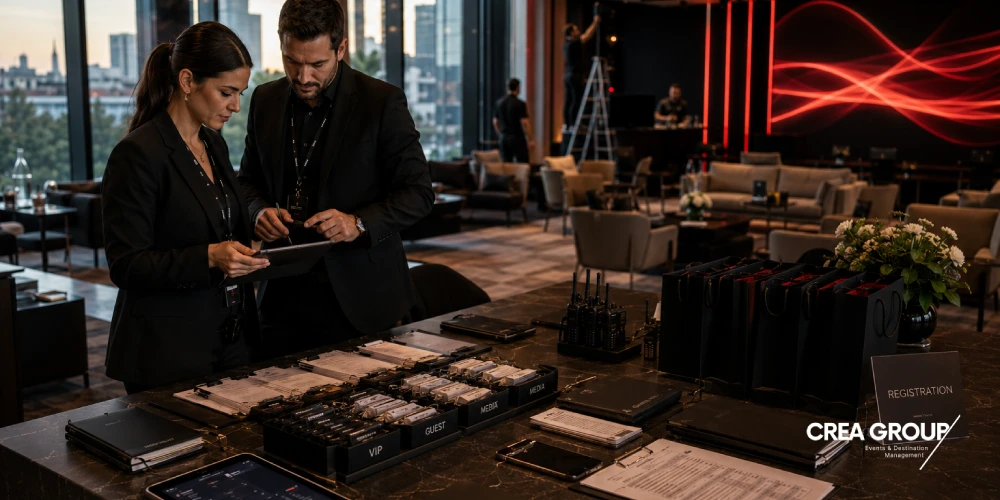
• ➝ Communicate the logistics to attendees (where, when, how to arrive, what to bring for access).
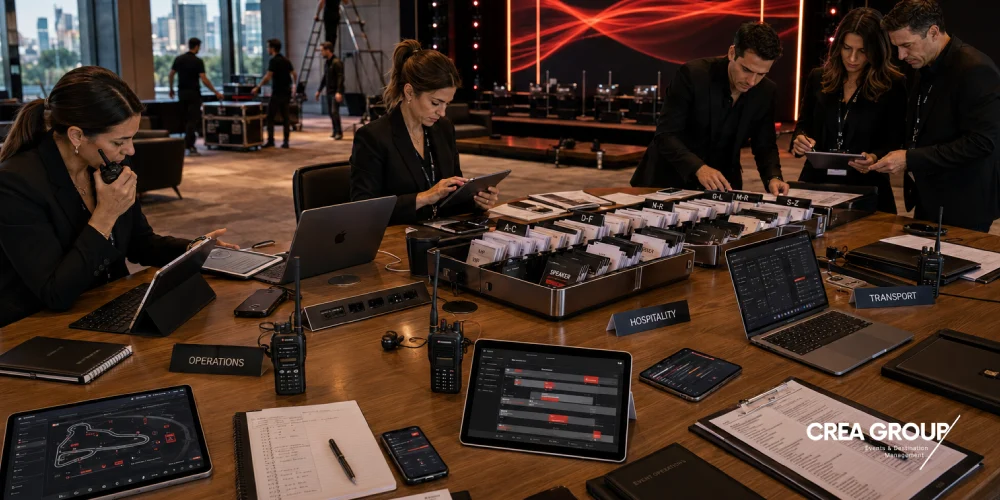
CREA Group coordinates corporate events in Madrid on peak-demand dates, with first-hand knowledge of how access, suppliers and timing behave when the city is at its limit. We help you bring forward the decisions that do not allow delay.
👉 Tell us the date and size of your event.
When the city is already in Grand Prix mode, it is time to confirm and not improvise:
• ➝ Reconfirm each supplier's arrival, schedule and access for those specific days.
• ➝ Check the real state of the published road closures and adjust transfers if needed.
• ➝ Confirm accreditations received and distributed, named and with the correct access.
• ➝ Review plan B with the team, so everyone knows what to do if something changes.
• ➝ Keep the direct contacts of each lead to hand (venue, transport, catering).
• ➝ Arrive before anyone at the critical point to validate access and build.
• ➝ Have a visible person responsible with authority to decide on the spot.
• ➝ Control the group's arrivals and trigger the transport plan B if closures require it.
• ➝ Keep a real-time communication channel open with all suppliers.
• ➝ Document what happens for the follow-up and the improvement of the next event.
After operating many events in high-demand environments, the failures repeat in a pattern. First: treating the booking like a normal event and arriving late to venue, hotel or suppliers when there is no longer an option. Second: planning transfers on the city's usual map, ignoring that the routes and times are different that weekend. Third: having no access plan B, so an unexpected road closure turns guest arrival into a problem with no way out. All three are avoided the same way: bring decisions forward and plan on the Grand Prix scenario, not on an ordinary weekend's.
Moment | Critical action | If done late |
3-6 months before | Book venue, hotel and suppliers | No availability left |
Weeks before | Routes, accreditations, plan B | Improvised logistics |
Race week | Reconfirm everything and adjust | Surprises on event day |
The day | Presence, arrival control | Problems with no one to solve them |
Three factors that do not exist on a normal weekend: availability (the whole city competes for the same spaces and suppliers), access (road closures and security perimeters) and timing (load-in windows compressed by the sporting event's calendar). The checklist is not the usual one with more tasks, but the usual one with brought-forward deadlines: what you usually decide three weeks before is decided three months ahead here.
Between three and six months ahead for the critical items (venue, accommodation, key suppliers), because on Grand Prix dates these resources sell out and become expensive. It is the block you cannot recover if done late: once availability is gone, there is no room to manoeuvre.
Three repeat: treating the booking like a normal event and arriving late to venue, hotel and suppliers; planning transfers on the city's usual map while ignoring the weekend's road closures; and not preparing an access plan B, so an unexpected closure blocks guest arrival. All three are avoided by bringing decisions forward and planning on the real Grand Prix scenario.
It is not compulsory, but it helps a lot. An operator experienced in high-demand dates in the city knows how access, suppliers and timing behave when Madrid is at its limit, and knows which decisions to bring forward. That field knowledge is the difference between an event that flows and one resolved through a series of scares.
If your project fits Borja's focus (international incentives, hospitality events, complex operations in Madrid), get in touch about working together.
Last updated: May 2026.

Borja Llopart
Borja Llopart is the CEO and founder of CREA Group Events & DMC. With over 20 years of experience in the MICE industry, he specialises in organising corporate events, congresses, meetings and incentive travel programmes in Spain. He served on the Board of Directors of SITE Spain & Portugal for nearly seven years, including as President of the association, and has been a member of the Tourism Committee at Foment del Treball since 2020.
Connect with Borja on LinkedIn →
Madrid Office: Cl. de Ayala, 82, 5th Floor, Salamanca, 28001 Madrid
Find us on Google Maps
Barcelona Office: Carrer de Santaló, 10, 3-1, Sarrià-Sant Gervasi, 08021 Barcelona
Find us on Google Maps