2026-05-29 00:00:00
Last updated: May 2026. Written by Cristina Parera Anglada, Event Designer, CREA Group Events & DMC.
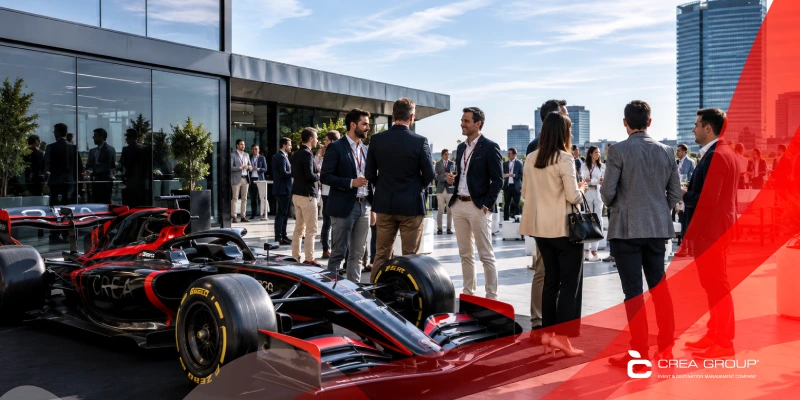
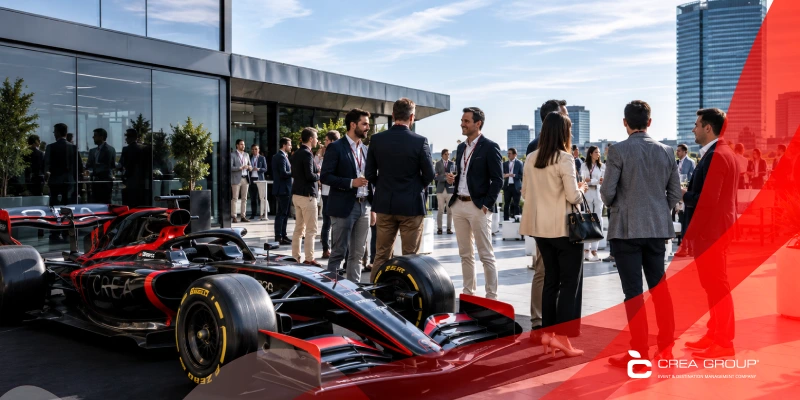
The year Madrid launches its Grand Prix is the perfect year for a team to experience Formula 1 from the inside, without needing a race ticket. The energy of the engines, the timing, the pit work: all of it translates surprisingly well into team dynamics that leave a mark. If you run your company's team building and want something that connects with the city's moment without falling back on the usual out-of-town karting, here is where to start. I will walk you through seven team-building formats with real F1 spirit that genuinely work for companies in Madrid, the team objective each one trains, and how to choose based on what you need to shift in your people.
→ Why F1 works so well as a team-building thread.
→ Seven formats and the team objective each one trains.
→ How to choose the format based on what you need to shift.
→ What turns a good team building into one that gets remembered.
Formula 1 is, at heart, a story about teams. The driver gets the photo, but what wins races is the whole: strategy, mechanics, engineers, communication under pressure, decisions in milliseconds. That is exactly the metaphor a good team building needs. There is no need to force it; it is already there.
And in 2026 there is a bonus: Madrid breathes motorsport. A team that runs an F1 dynamic in the year of the city's first Grand Prix feels part of something that is happening, not of a generic activity pulled from a catalogue. That shared context is half the emotional work already done.
👉 See how we design team building for companies in Madrid.
Not every team building seeks the same thing. Some want to break the ice in a new team, others to reward a team that has pushed hard, others to improve communication between departments. These seven formats cover different objectives.
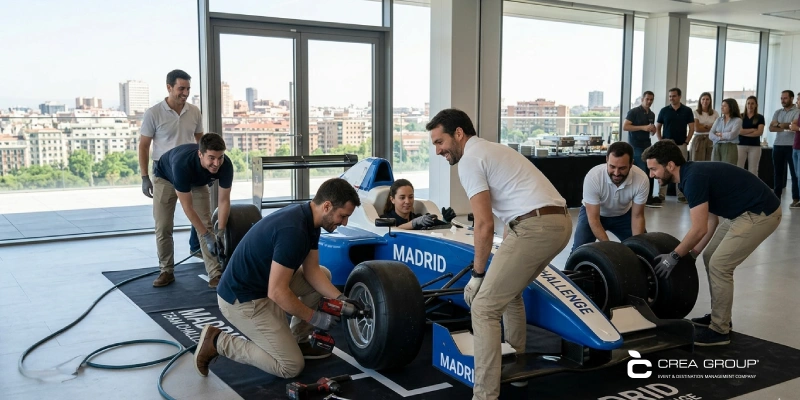
1️⃣ Pit stop challenge: tyre change against the clock.
The classic that never fails. Teams compete to make the fastest, most coordinated wheel change. It trains coordination under pressure and makes it crystal clear, in thirty seconds of chaos, that speed without method gets you nowhere. Ideal for teams that need to see the value of each person's role.
2️⃣ Building an F1 car (cardboard, kit or radio-controlled).
The team designs, builds and decorates its single-seater, then races it. It trains creativity and task sharing. It works very well with large groups split into stables, because each sub-team develops its own identity.
3️⃣ Race strategy: a pit-wall decision simulation.
A more cerebral format. Teams play the pit wall and make strategy calls (stops, tyres, weather) with partial information and limited time. It trains decision-making with incomplete data, which is exactly what management teams live.
4️⃣ Professional driving simulators.
Competition on quality simulators. It trains individual handling of pressure within a team frame (ranked by stable). It is the most adrenaline-driven format and the one that works best as a reward for a team that has delivered.
5️⃣ Paddock gymkhana by stations.
A circuit of varied challenges (reflexes, precision, communication, motorsport trivia) that the team works through by station. It trains versatility and rotating leadership, because each station rewards a different skill and a different leader emerges at each one.
6️⃣ Masterclass from a motorsport professional plus a dynamic.
A talk from someone in the motorsport world (driver, engineer, team boss) followed by a dynamic that applies what was learned. It trains inspiration and transferable learning. The credibility of a real voice is hard to match.
7️⃣ Hybrid experience: a real paddock day during the GP.
For high budgets and select groups: combining the team dynamic with a hospitality component during Grand Prix weekend. It trains cohesion and high-level recognition. It is the incentive option more than pure team building, and it needs booking far ahead.
CREA Group has designed team experiences in Madrid for 19 years, always starting from the HR objective rather than the activity. We help you choose the format that shifts what you need to shift, not the one that sounds best in a brochure.
👉 Tell us what you want to achieve with your team.
The question is not "which activity is coolest", but "what is happening to my team and what do I want to change".
A quick guide:
➝ A new or recently merged team that needs to break the ice: pit stop challenge or car build, formats where they mix and collaborate fast.
➝ A team that communicates poorly across areas: race strategy or gymkhana, which force them to share information and depend on one another.
➝ An exhausted team that deserves recognition: simulators or the hybrid paddock experience, formats that reward and bring adrenaline.
➝ A team that needs inspiration or a culture reset: a masterclass from a motorsport professional.
If you hesitate between two, the one more aligned with the business objective always wins, not the flashier one. A simple, well-focused format beats a spectacular one without purpose.
The activity is just the vehicle. What makes a team keep talking about the day weeks later is the close: the moment someone connects what happened in the dynamic with how they actually work. A pit stop that goes wrong and is then discussed ("we never said who did what, like the March project") is worth more than ten activities without reflection.
That is why a good team-building design reserves time for that close and facilitates it with someone who knows how to lead it. F1 gives the exciting wrapper; the learning comes from the conversation that follows. To see how this fits into a wider programme around the Grand Prix, we cover it in the corporate hospitality F1 Madrid guide.
Format | Objective it trains | Ideal size | Energy |
Pit stop challenge | Coordination under pressure | Medium-large | High |
Car build | Creativity, task sharing | Large (stables) | Medium |
Race strategy | Decisions with incomplete data | Small-medium | Medium |
Professional simulators | Handling pressure | Any | Very high |
Paddock gymkhana | Versatility, rotating leadership | Medium-large | High |
Masterclass plus dynamic | Inspiration, learning | Any | Medium |
Real paddock at the GP | Cohesion, recognition | Small, select | High |
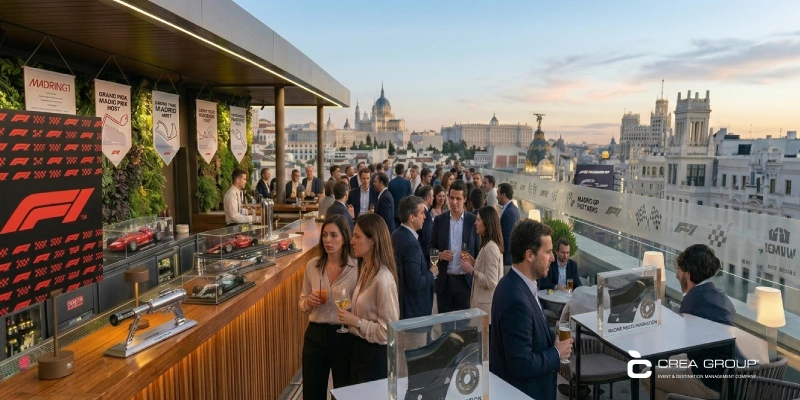
The ones that start from a clear team objective. A pit stop challenge trains coordination under pressure; building a car trains creativity and task sharing; a race-strategy simulation trains decision-making with incomplete data; simulators train individual handling of pressure. The best activity is the one aligned with what your team needs to shift, not the flashiest.
No. Most formats (pit stop, car build, simulators, gymkhana, masterclass) run in any event space on any day of the year and need no race ticket. Only the real paddock experience during Grand Prix weekend requires event access, and that one needs booking far ahead.
It depends on the format. Car builds by stable and gymkhanas scale well to large groups; race strategy works best in small or medium groups; simulators adapt to any size by running turns. A good design fits the format to the number of people, not the other way around.
Beyond the satisfaction on the day, what shows it worked is whether the team connects the experience to how they work. That is why the facilitated close (the conversation that translates the dynamic into real learning) is the part that leaves the most impact, and it is worth reserving time for it in the design.
If you want to discuss a creative team project (team building with a concept, internal-culture event, dynamic with brand narrative), get in touch about working together.
Last updated: May 2026.
Cristina Parera Anglada
Cristina Parera Anglada is Senior Accounts Director at CREA Group Events & DMC. A graduate of ESADE Business School, she has nearly 18 years of experience in the MICE industry. She specialises in delivering incentive programmes across Spain's leading destinations, as well as managing complex event operations and high-profile projects for international clients.
Connect with Cristina on LinkedIn →
Madrid Office: Cl. de Ayala, 82, 5th Floor, Salamanca, 28001 Madrid
Find us on Google Maps
Barcelona Office: Carrer de Santaló, 10, 3-1, Sarrià-Sant Gervasi, 08021 Barcelona
Find us on Google Maps