2021-01-07 00:00:00
Last updated: May 2026. Written by Borja Llopart, Senior Event Planner, CREA Group Events & DMC.
Choosing a Destination Management Company in Spain looks like a procurement decision: you shortlist three names, compare proposals, pick the one that answers fastest. The problem is that most shortlists mix two very different kinds of company, and the proposal rarely tells you which is which. Some DMCs run the operation on the ground with their own teams. Others forward your brief to a chain of subcontractors and add a margin. Both send polished decks. This guide gives you the questions that separate the two, how a DMC differs from a local agency, how agency-to-DMC billing works in Spain, and the warning signs that tell you to walk away before you sign.
→ What a DMC in Spain actually does (and what it does not)
→ DMC vs local agency vs intermediary: a comparison by criteria
→ The questions that reveal whether a DMC operates or subcontracts
→ How agency-to-DMC billing works in Spain
→ Warning signs to check before you sign → What good looks like: a short checklist
A Destination Management Company is the local operator that turns a brief written in London, New York or Paris into an event that happens on the ground in Spain. The acronym stands for Destination Management Company, and in the MICE sector it means the partner who holds the local knowledge: venues, suppliers, permits, transport, staffing, and the timing rules that only repetition teaches. If you want the full definition and history of the term, we cover it in what a DMC is.
What a DMC does not do is replace your own role as the client's contact. A good DMC in Spain operates as an extension of your team, not as a competing brand. That distinction matters most for international agencies, and we come back to it below.
The confusion in the market is that the label "DMC" is unregulated. A two-person reseller can call itself a DMC. So can a company with operational offices and certified suppliers. The word tells you nothing. The structure behind it tells you everything, which is why the rest of this guide is about reading the structure.
👉 See how our DMC services in Spain work.
These three terms get used interchangeably, and the difference is not academic. It changes who is accountable when something moves at the last minute.
A DMC holds direct relationships with venues and suppliers in the destination and coordinates the operation onsite. A local event agency may be excellent creatively but often works in a single city and subcontracts logistics outside it. An intermediary (sometimes called a broker) takes your brief and places it with whoever is available, adding a layer between you and the people doing the work. The more layers between you and the operation, the longer the response time when a transfer is delayed or a venue changes its load-in window.
Here is how the three compare on the criteria that decide outcomes:
Criterion | DMC with own operation | Local agency | Intermediary / broker |
|---|---|---|---|
Direct supplier relationships | Yes, contracted directly | Partial, city-dependent | No, places with third parties |
Geographic coverage | Multi-city | Usually single city | Variable |
Onsite team | Own staff | Own staff in home city | Rarely |
Response time on last-minute changes | Hours | Hours in home city | Days |
Accountability when something fails | Single point | Single point | Split across parties |
Languages handled onsite | Often 3+ | 1-2 | Variable |
The table is not a verdict. A local agency in its home city can outperform a generalist DMC. But for a multi-city programme, or an event where you will not be physically present, the number of layers between you and the operation is the single most useful thing to measure. We go deeper into this in DMC vs local agency.
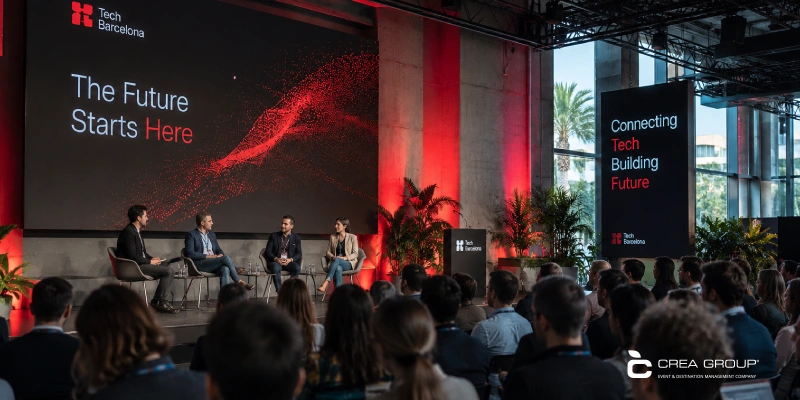
CREA Group runs MICE operations from owned offices in Barcelona and Madrid, with field coverage across Barcelona, Madrid, Seville, Valencia, Mallorca and Málaga. That means the same team is accountable whether your event moves between two cities or stays in one, with no broker in the middle.
👉 Tell us where your event needs to happen.
This is the part most procurement checklists miss. A proposal will not tell you whether a DMC operates or resells. The answers to a few specific questions will. Ask these in the first call, not after you have shortlisted.
1️⃣ "Which suppliers on this proposal do you contract directly, and which do you place through a partner?"
A DMC that operates will answer immediately and name the split. One that resells will deflect to "our network" without specifics. The vague answer is the answer.
2️⃣ "Who is physically onsite on event day, and are they your staff or freelancers hired for this project?"
There is nothing wrong with freelancers for scale. The warning sign is a company that cannot tell you the ratio, or that has no senior staff of its own present at all.
3️⃣ "What happens operationally if the venue cancels 48 hours out?"
You are listening for a concrete process, not reassurance. A real operator describes the plan B venues they would call and roughly how long a swap takes. A reseller describes how upset they would be.
4️⃣ "How many languages can your onsite team work in during the event itself, not just in email?"
For international groups this is decisive. Simultaneous interpretation for a keynote, multilingual signage and RSVP handling in three languages are operational tasks, not commercial ones.
5️⃣ "Can you show membership of an association that audits its members?"
Memberships such as SITE (Society for Incentive Travel Excellence) and ADMEI (Association of Destination Management Executives International) require more than paying a fee. ADMEI in particular is the membership international agencies tend to check first. You can verify both directly on the associations' own member directories.
The pattern across all five questions is the same: specificity is the signal. An operator answers with names, ratios and timeframes. A reseller answers with adjectives.
If you are an international agency placing an event in Spain rather than the end client, the commercial relationship has particularities worth knowing before the first invoice arrives. The headline issue is cross-border VAT: services to an EU-registered agency are often handled under intra-community rules, frequently reverse-charged rather than added on the Spanish invoice, while non-EU clients are treated differently again. The detail matters enough that we wrote a separate piece on VAT and invoicing for a Spain DMC. This is not tax advice, so confirm specifics with your finance team; the practical point is to clarify the invoice structure at proposal stage, not at payment.
The second particularity is white-label discretion. A serious DMC working with an agency will commit, in writing, not to contact the end client directly. If that commitment is not on the table, treat it as a warning sign for an agency relationship.
CREA Group works as a white-label partner for incentive houses and agencies in the UK, US, France and Germany, operating under your brand and reporting into your team. Discretion toward your end client is part of the agreement, not an afterthought.
👉 Ask us how we work with international agencies.
Five things that, in combination, tell you to slow down:
➝ No named onsite lead.
If you cannot get the name and role of the person running event day, the operation is being assembled rather than delivered.
➝ "Network" with no specifics.
Networks are good. Networks no one will describe are a layer you are paying for without seeing.
➝ No verifiable certification or membership.
Claims of sustainability or quality with nothing auditable behind them are claims, not credentials.
➝ Reluctance to put the plan B in writing.
Every experienced operator has a contingency process. Reluctance to describe it usually means there is not one.
➝ A proposal that is all adjectives.
If the deck describes feelings rather than logistics, the company sells events rather than runs them.
None of these alone is disqualifying. Three or more together is a pattern.

Before you sign, you should be able to tick all of these:
➝ You know which suppliers are contracted directly and which are placed.
➝ You have the name and role of the onsite lead.
➝ You have a written contingency process for venue or supplier failure.
➝ You have confirmed the languages the onsite team works in.
➝ You have verified at least one auditable membership or certification.
➝ (If you are an agency) you have a written white-label and non-solicitation commitment.
➝ (If you are an agency) you have clarified the VAT and invoicing structure.
If any box is empty after the proposal stage, the next conversation is worth having before the contract is.
Factor | DMC (own operation) | Local agency | Intermediary |
|---|---|---|---|
Best for | Multi-city, remote client, international groups | Single-city creative events | Simple, single-supplier needs |
Layers to operation | One | One (in home city) | Two or more |
Last-minute response | Hours | Hours (home city) | Days |
Onsite accountability | Single point | Single point | Shared |
White-label for agencies | Common | Rare | Variable |
Languages onsite | Often 3+ | 1-2 | Variable |
DMC stands for Destination Management Company. In the MICE sector it refers to the local company that plans and operates corporate events, incentives, congresses and meetings in a specific destination, handling venues, suppliers, transport, staffing and onsite coordination on behalf of a client or agency based elsewhere.
A travel agency typically books individual travel and accommodation. A DMC operates the full ground programme of a corporate event in the destination: sourcing venues, coordinating suppliers, managing transport and staffing, and running the event onsite. The DMC is operational and B2B; the travel agency is mostly transactional.
Ask which suppliers it contracts directly versus places through a partner, who is physically onsite on event day, and what its written process is if a venue cancels 48 hours out. An operator answers with names, ratios and timeframes. A reseller answers with general reassurance and a "network" it will not describe.
Yes. Many established DMCs in Spain work white-label for international agencies and incentive houses, operating under the agency's brand and committing in writing not to contact the end client directly. If a DMC will not put that non-solicitation commitment in writing, treat it as a warning sign for an agency relationship.
For agencies registered for VAT elsewhere in the EU, services are often handled under intra-community VAT rules, frequently with VAT reverse-charged to the agency rather than added on the Spanish invoice, provided both parties have valid intra-community VAT numbers. Treatment varies by service and by current rules, so confirm specifics with your finance team and clarify the invoicing structure at proposal stage.
Last updated: May 2026.
Depending on how far along you are:
➝ Still comparing models? Read DMC vs local agency for corporate events.
➝ Ready to scope a project? See what we cover on the DMC services in Spain page.
➝ Want a person, not a page? Talk to our team about your event.

Borja Llopart
Borja Llopart is the CEO and founder of CREA Group Events & DMC. With over 20 years of experience in the MICE industry, he specialises in organising corporate events, congresses, meetings and incentive travel programmes in Spain. He served on the Board of Directors of SITE Spain & Portugal for nearly seven years, including as President of the association, and has been a member of the Tourism Committee at Foment del Treball since 2020.
Connect with Borja on LinkedIn →
Madrid Office: Cl. de Ayala, 82, 5th Floor, Salamanca, 28001 Madrid
Find us on Google Maps
Barcelona Office: Carrer de Santaló, 10, 3-1, Sarrià-Sant Gervasi, 08021 Barcelona
Find us on Google Maps